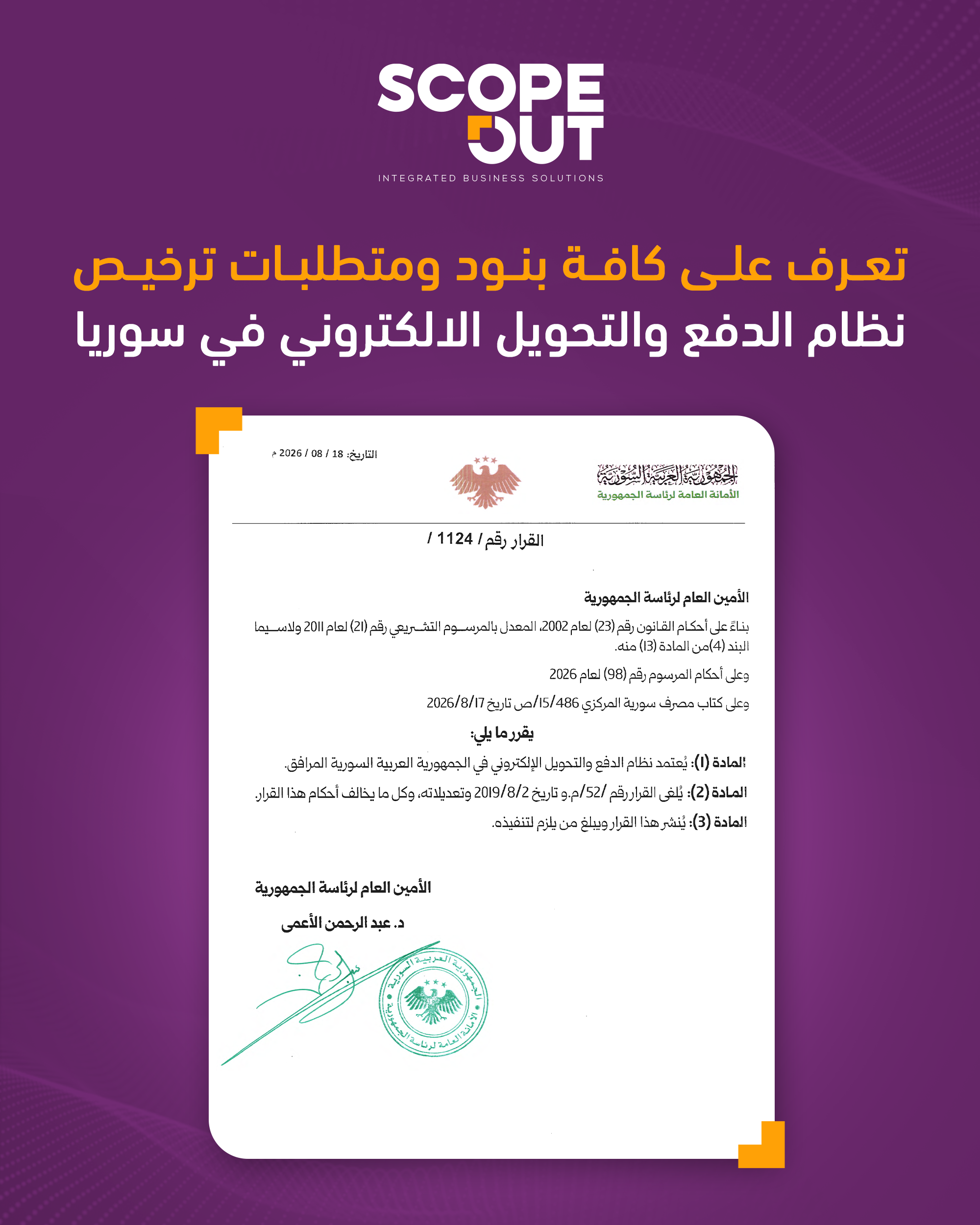
In March 2026, the Syrian Ministry of Economy and Industry issued a new circular aimed at unifying procedures across all company departments and Commercial Registry offices in different governorates. The decision comes as part of broader efforts to regulate commercial activities, simplify administrative procedures, and create a more organized business environment in Syria.
One of the most important aspects of the circular is the standardization of how commercial activities are registered. The circular allows individuals and companies to include up to five different activities in a single commercial registration, whether these activities are primary, secondary, or supportive. However, all activities must be classified according to the Syrian Standard Industrial Classification (SYRSIC) to ensure consistency and clarity across all commercial registries.
This step aims to reduce inconsistencies between different registry offices and ensure that business activities are properly defined and documented.
The circular also regulates the use of the term “Import and Export” in commercial registrations. Companies must explicitly state import and export activities in their commercial objectives and clearly define the types of goods or sectors they intend to operate in, with a maximum of five sectors.
In addition, the phrase “participating in tenders and auctions” may only be included if it is directly related to the company’s core business activity, preventing the use of overly broad or vague commercial objectives.
The circular introduces specific restrictions related to foreign investors and foreign-owned businesses. Individual commercial registrations granted to foreigners do not include import activities, except in cases related to investment projects covered under the Investment Law, where imports are limited to equipment and materials necessary for the project.
Additionally, the circular prohibits non-Syrians from registering activities related to representing foreign companies or commercial agencies in Syria under individual or corporate commercial registrations.
The main objective of this decision is to:
Unify procedures across all Commercial Registry offices.
According to economic analysts, the circular is part of broader efforts to streamline administrative processes and regulate commercial activity, especially with the increase in foreign companies and branches registering in Syria in recent years.
This decision means that companies planning to establish a business in Syria must now pay closer attention to:
In practical terms, company formation in Syria is becoming more structured and regulated, which makes proper legal and business planning essential before starting the registration process.
The new circular does not only introduce administrative changes; it reflects a broader move toward organizing and regulating the business environment in Syria. While the decision may add more procedural clarity and structure, it also requires investors and companies to prepare their legal and operational setup more carefully before registering a company.
For investors entering the Syrian market, understanding these new procedures and structuring the company correctly from the beginning is now more important than ever to avoid delays, rejections, or future amendments to the commercial registry.