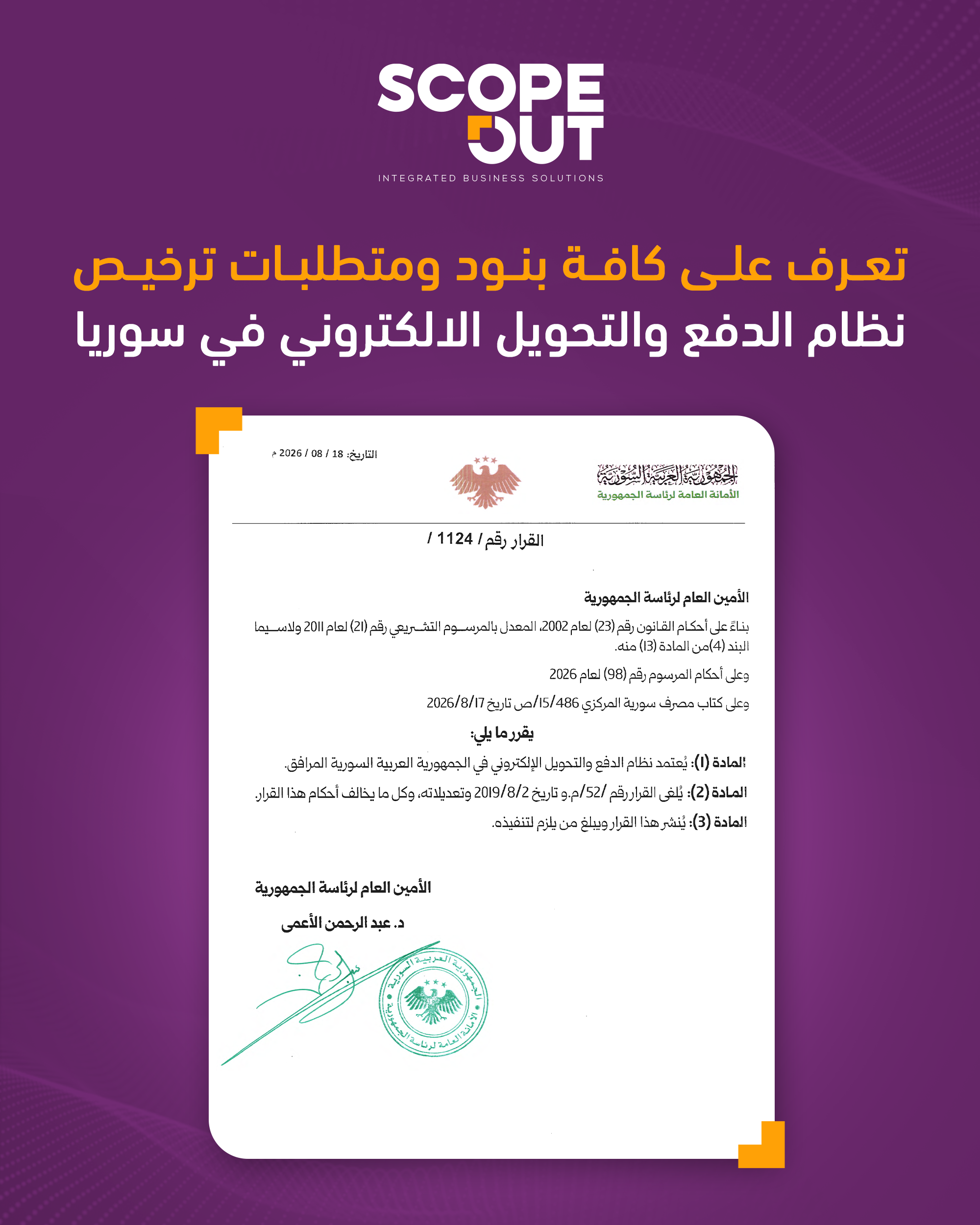
Electronic payment and collection services constitute a vital sector garnering increasing interest in Syria, given their pivotal role in advancing digital financial transactions, streamlining payment processes, and connecting companies and institutions with banks and authorized electronic channels.
Establishing a company specialized in electronic payment and collection services necessitates obtaining approvals and a license from the competent authorities—foremost among them, the Central Bank of Syria—in accordance with a specific set of documentary, technical, financial, and legal requirements.
The licensing procedure commences with the submission of a written application detailing the names of the founders and their respective equity contributions. This application must be accompanied by the requisite legal documentation, such as national ID cards or passports, commercial registry extracts for corporate entities, criminal record certificates, and a draft of the company’s Articles of Association or Memorandum of Association.
The Memorandum of Association must explicitly outline the services intended to be provided—ensuring full compliance with all applicable laws and regulations—and include a statement demonstrating relevant expertise in the field of electronic payments and collections, as well as a detailed explanation of the electronic tools and channels to be utilized in delivering these services.
Furthermore, it is a mandatory requirement that the founders possess adequate financial solvency and demonstrate a minimum of two years of professional experience in the electronic payment and collection sector; notably, the aggregate equity contribution of those founders possessing such expertise must amount to no less than 25% of the company’s total capital.
Upon securing preliminary approval, the company proceeds to complete the final registration and licensing formalities. This involves submitting the official Commercial Registry Certificate, the operational framework and mechanisms governing service delivery, copies of all agreements concluded with banking institutions, and a formal statement listing the names of the members of the Board of Directors or the company’s executive management team. The company is required to provide suitable premises, establish the necessary technical infrastructure, and appoint qualified personnel across administrative, financial, legal, technical, and technological fields.
Electronic payment companies are required to formulate clear operational management policies. These policies must encompass risk management, business continuity and contingency planning, internal auditing, information security, data protection, and customer service.
Furthermore, the company must appoint a General Manager possessing a minimum of ten years of experience in the fields of electronic transactions, electronic payments, or e-commerce, and who holds a university degree in Economics, Business Administration, or Informatics.
Electronic payment companies may not conduct their operations independently of the banking sector. Consequently, they are required to enter into an agreement with at least one commercial bank or a social banking financial institution, clearly delineating the roles and responsibilities of each party.
The management of balances associated with electronic payments remains the exclusive prerogative of banks operating within Syria; moreover, these balances must be fully collateralized (100% coverage).
Additionally, subject to obtaining the requisite approvals, these companies may collaborate with banks to issue co-branded cards, pursuant to contractual agreements that define the respective responsibilities and operational protocols.
Electronic payment companies are subject to the oversight and supervision of the Central Bank of Syria and the Monetary and Credit Council. Furthermore, they are required to strictly adhere to all applicable laws and regulations concerning banking secrecy, anti-money laundering and counter-terrorist financing (AML/CFT), electronic transactions, electronic signatures, and cybercrime. Furthermore, the Central Bank of Syria reserves the right to revoke preliminary approval if the company fails to complete its registration procedures within one year, or to revoke the license in the event of a violation of applicable laws, a cessation of business operations, or a failure to commence operations within the specified timeframe.
ScopeOut assists investors and entrepreneurs seeking to enter the electronic payment and collection sector in Syria by analyzing regulatory requirements, preparing necessary documentation, establishing operational structures, facilitating relationships with banks, and providing the requisite advisory support to develop a business model that fully complies with current laws and regulations.
Leveraging its expertise in company formation, market entry, and project structuring, ScopeOut transforms the concept of investing in this sector into a clear and organized roadmap—one that mitigates risks and enhances the likelihood of securing the necessary regulatory approvals.